Cost guide
Track Cursor, OpenRouter, and Gemini CLI spend together
Where Cursor, OpenRouter, and Gemini CLI each report usage, why their numbers differ in kind, and how to see all three on a Mac in one place.
· Facts checked October 3, 2026
- Cursor
- OpenRouter
- Gemini CLI
- OpenCode

The short answer
Each tool reports a different kind of number: Cursor shows included usage against your plan in dollars at API rates, OpenRouter reports what each API key has spent in credits, and Gemini CLI shows token counts per session with /stats. Tracking them together means keeping reported spend and token-based estimates side by side without adding them up as if they were the same thing.
At a glance
| Cursor | Included usage measured at each model's API rates, shown in editor settings and the Cursor usage dashboard. |
|---|---|
| OpenRouter | Spend per API key, daily, weekly, and monthly, from its key endpoint. |
| Gemini CLI | /stats shows the session's tokens; free sign-in allows 1,000 requests a day. |
| OpenCode | Keeps usage in a local database on your machine. |
| Mixing them | Reported spend and API-equivalent estimates should stay separate. |
Cursor: included usage in dollars
Cursor's paid plans include usage that is consumed at each model's API cost, so a more expensive model uses up the allowance faster. Pro is $20 a month, Pro Plus $60, and Ultra $200. When the included usage runs out, you can add on-demand usage at the same API rates or move up a plan.
Both usage pools appear in Cursor's editor settings and on its usage dashboard. Admins on Cursor Enterprise can also read the whole team's usage through an admin API key.
OpenRouter: spend per API key
OpenRouter bills prepaid credits and reports what each API key has used. Its key endpoint returns all-time usage plus daily, weekly, and monthly figures, and the remaining amount when the key has a credit cap. Because one key can route to many models, the per-key number is often the clearest view of spend.
Token-level detail, such as which model ran or how much was cached, lives in OpenRouter's activity records rather than in the key total.
Gemini CLI and OpenCode: local history
Gemini CLI shows the current session's token usage with /stats, including cached tokens when caching is active. Signing in with a personal Google account allows 60 requests a minute and 1,000 a day at no charge, so a dollar figure only exists if you price the tokens yourself. OpenCode stores its sessions in a local database.
For both, an API-equivalent estimate, the tokens multiplied by the provider's published rates, is the comparable number. The glossary entry on API-equivalent cost explains what that estimate does and does not mean.
Seeing all of them in one place
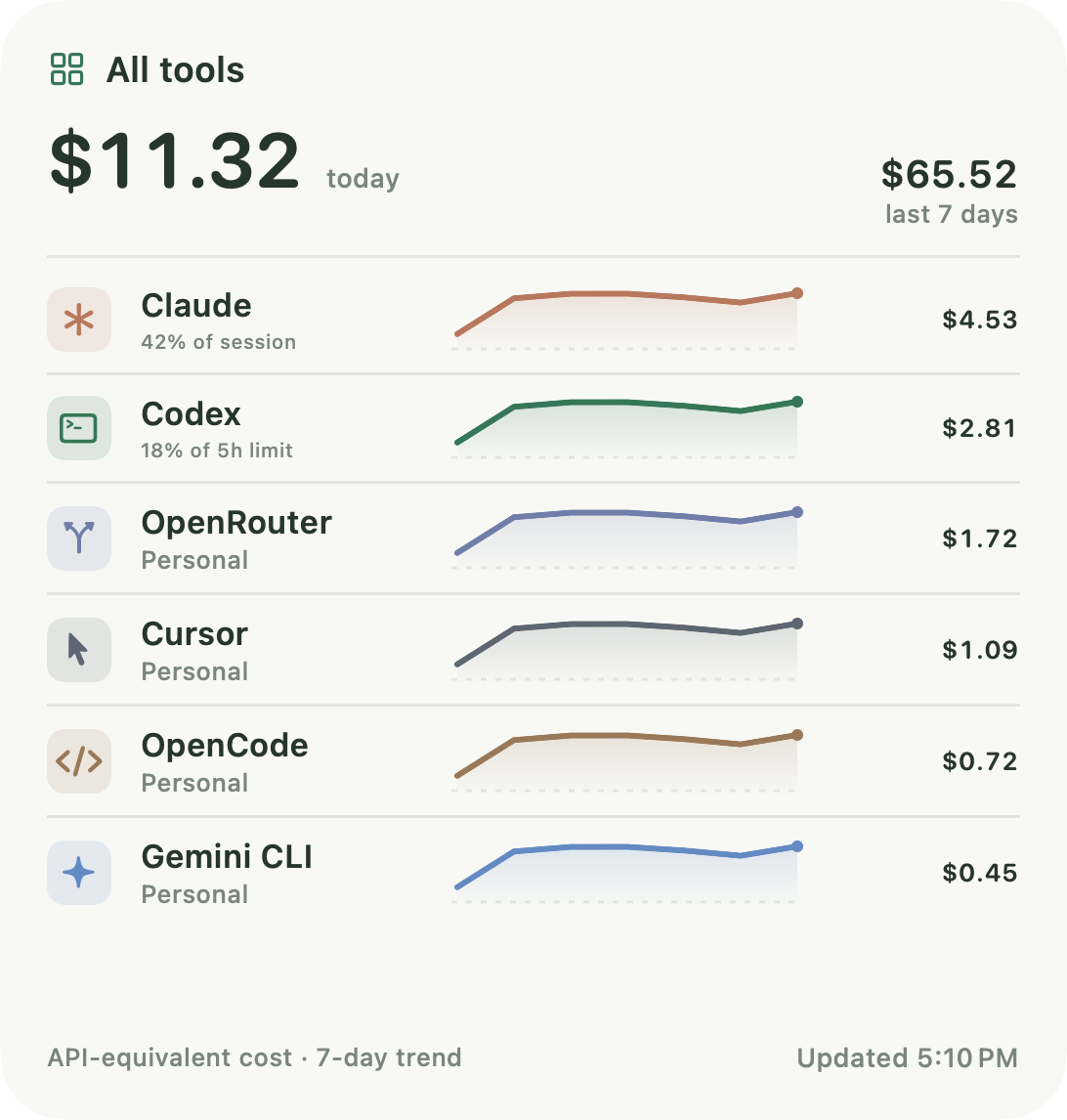
everyaitoken connects to each tool the way that tool allows: Cursor through the sign-in Cursor already saved on your Mac or an Enterprise admin API key, OpenRouter through an API key you paste in, and Gemini CLI and OpenCode through their local history. Reported spend from Cursor and OpenRouter is shown as reported and never mixed into the token estimates, and unknown prices are flagged as partial rather than guessed. Claude Code and Codex sit in the same view; the Claude Code cost guide covers that side.
Your own numbers
See what your AI coding really costs.
everyaitoken reads Claude Code, Codex, Cursor, OpenRouter, Gemini CLI, and OpenCode on your Mac. It shows limits with reset times, API-equivalent cost, and what caching saved or cost, in the menu bar and 17 widgets. $9 once.
FAQ
Questions
How do I see my Cursor usage?
Open Cursor's settings in the editor or its usage dashboard on the web. Both show your included usage pools, measured in dollars at each model's API rates.
How do I check how much an OpenRouter key has spent?
OpenRouter's key endpoint returns the key's all-time usage and its daily, weekly, and monthly usage, plus the remaining amount if the key has a credit cap.
Does Gemini CLI show token usage?
Yes. Run /stats during a session to see total tokens, with a cached field when caching is active. Headless JSON output includes the same figures per model.
Can I add Cursor spend and Claude Code cost together?
Only with care. Cursor reports spend against a plan, while a Claude Code figure on a subscription is an estimate at API rates. Keep them side by side rather than summing them into one bill.
Sources
Checked October 3, 2026. Plans and limits change; the linked pages are the authority.