Cost guide
How much does Claude Code cost per day?
What Claude Code costs per active day at API rates, according to Anthropic's own figures, and how to work out your own number on a Pro or Max plan.
· Facts checked October 3, 2026
- Claude Code
The short answer
Anthropic reports that enterprise teams using Claude Code through the API average about $13 per developer per active day, or $150 to $250 a month, and that 90% of users stay under $30 per active day. On a Pro or Max plan you pay the flat subscription instead, so the useful daily number is your API-equivalent cost: what the same tokens would cost at API rates.
At a glance
| Average API cost | About $13 per developer per active day (Anthropic, enterprise API deployments). |
|---|---|
| Monthly range | $150 to $250 per developer per month. |
| Most users | 90% stay under $30 per active day. |
| On a subscription | Pro $20, Max 5x $100, Max 20x $200 a month, with usage limits instead of per-token charges. |
| Biggest cost drivers | The model, the size of the context resent each turn, and how much of it is served from cache. |
Why the daily cost varies so much
An agentic coding session resends the whole conversation with every request: your instructions, the files Claude Code has read, and every earlier step. Most of that context is served from the prompt cache at a fraction of the input price, but the share that is not cached, and the output Claude writes, are billed at full rates.
The model is the other lever. At the rates on this site, Claude Opus 5.5 costs $4 per million input tokens and $20 per million output tokens, twice the $2 and $10 of Claude Sonnet 5. A day of heavy work on Opus therefore lands well above the same day on Sonnet, even with identical prompts.
What it means on a Pro or Max plan
Subscribers do not pay per token. Claude Code's own session cost figure is meant for API users, and Anthropic notes it is not relevant to subscription billing. What a subscriber spends is the plan price, plus any usage credits bought after hitting a limit, which are billed at API rates.
The per-token number is still worth knowing. If your API-equivalent cost is $15 on an active day, twenty such days come to about $300 of usage, which tells you how much value a $100 or $200 plan returns and whether paying per token would cost more. The Max plan guide works through that comparison.
How to see your own daily cost
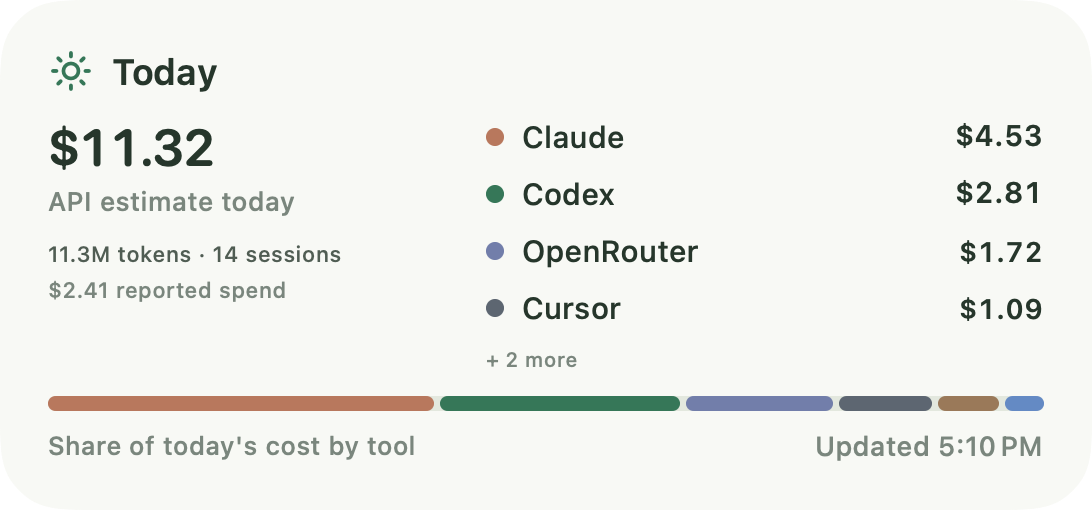
Inside Claude Code, /usage attributes recent usage to skills, subagents, and MCP servers. For a running total across days, everyaitoken reads Claude Code's local history on your Mac and prices every request at Anthropic's API rates, with input, cache reads, cache writes, and output priced separately. The result is an API-equivalent estimate, not a charge, and it shows per day, per model, and per session.
If caching is part of the question, the guide to when caching costs more explains why a day's cache line can be negative.
Your own numbers
See what your AI coding really costs.
everyaitoken reads Claude Code, Codex, Cursor, OpenRouter, Gemini CLI, and OpenCode on your Mac. It shows limits with reset times, API-equivalent cost, and what caching saved or cost, in the menu bar and 17 widgets. $9 once.
FAQ
Questions
What is the average Claude Code cost per developer?
Anthropic reports about $13 per developer per active day for enterprise API deployments, $150 to $250 per developer per month, with 90% of users under $30 per active day.
Is Claude Code cheaper on a subscription than on the API?
For steady daily use, usually. A plan charges a flat monthly price with usage limits, while the API bills every token. Compare your monthly API-equivalent cost with the plan price to see which is lower for you.
Why does Claude Code show a session cost if I am on Max?
That figure is meant for API users. Anthropic notes it is not relevant to subscription billing, but it is a useful API-equivalent cost for judging how much usage your plan delivers.
How can I lower my Claude Code cost?
Use a lighter model for routine work, keep context small with focused sessions, and avoid long idle gaps that let the cache expire and force rewrites.
Sources
Checked October 3, 2026. Plans and limits change; the linked pages are the authority.
